Homebrewing formulas help brewers predict alcohol content, bitterness, color, efficiency, carbonation, and other important characteristics of a finished beer. Although brewing software performs many of these calculations automatically, understanding the math makes it easier to design recipes, troubleshoot unexpected results, and improve consistency from one batch to the next.
This reference collects the most useful beer brewing calculations in one place. Each section explains what the formula measures, defines its variables, and provides a practical example. Bookmark this page for quick access during recipe development, brew day, fermentation, and packaging.
Disclaimer: This article may contain affiliate links, including links to Amazon. As a result, we may earn a small commission from qualifying purchases at no additional cost to you.
🍺 Original and Final Gravity Formula
These are the backbone of homebrewing formulas.
- Original Gravity (OG): Sugar content before fermentation
- Final Gravity (FG): Sugar left after fermentation
They’re measured with a hydrometer or refractometer.
🍻 Alcohol By Volume (ABV) Formula
Alcohol by volume estimates the percentage of alcohol in a finished beer using its original gravity and final gravity.
Formula:
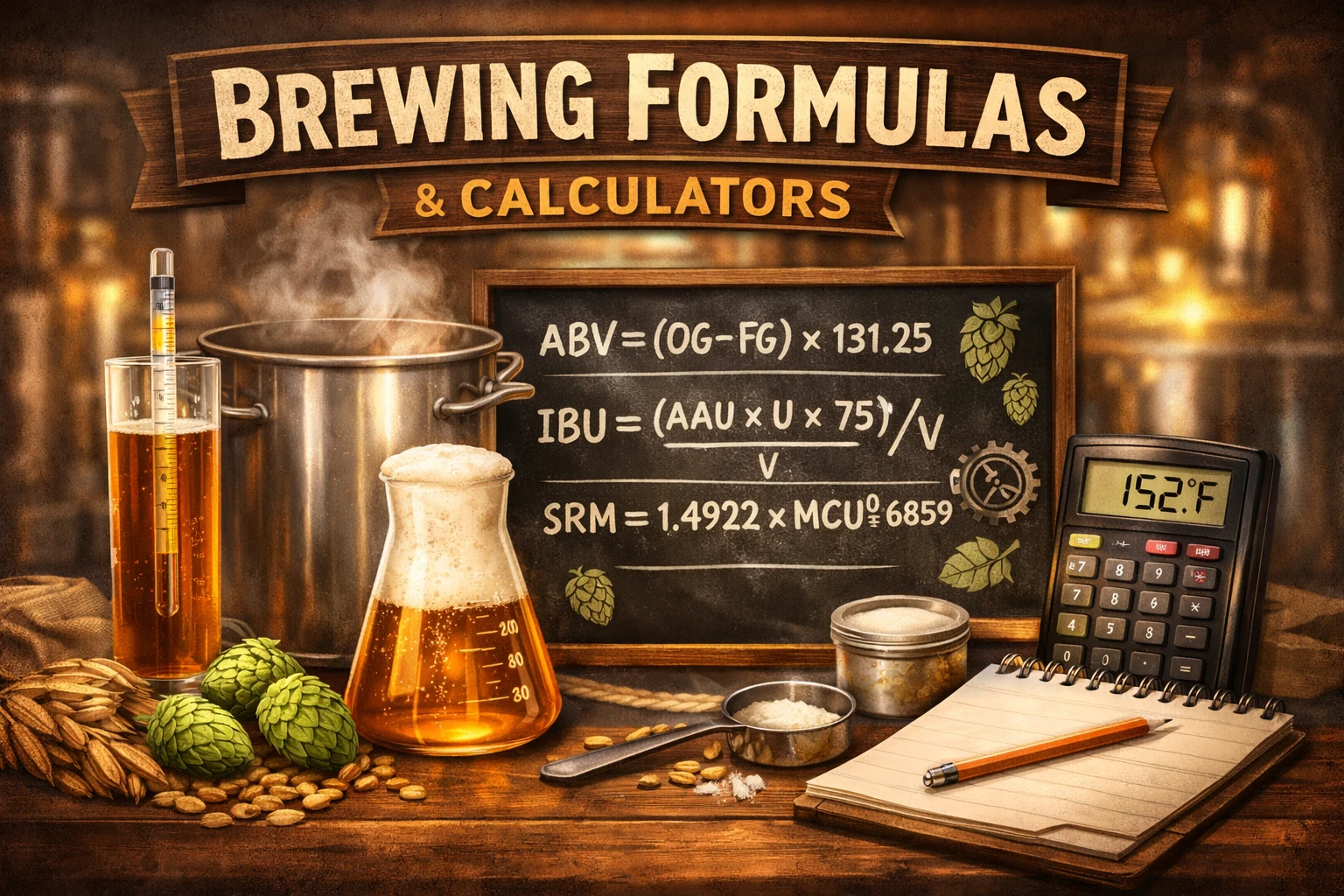
ABV = (OG − FG) × 131.25
Example:
For a beer with an original gravity of 1.052 and a final gravity of 1.012:
(1.052 − 1.012) × 131.25 = 5.25% ABV
The familiar simplified ABV equation is an estimate, so the page should describe calculated results as approximate rather than exact.
👉 This is one of the most used formulas in brewing.
Alcohol By Volume (ABV) Calculator
Enter your Original Gravity (OG) and Final Gravity (FG) to estimate your beer’s alcohol content.
🌾 Brewhouse Efficiency Formula
Measures how well you extract sugars from your grains.
Formula:
Efficiency (%) = (Actual Gravity Points / Potential Gravity Points) × 100
- Helps you dial in your system
- Typical homebrew range: 65%–80%
Brewhouse Efficiency Calculator
Measure how efficiently your system extracts fermentable sugars from your grain bill.
🌿 IBU Calculations Formula
Determines how bitter your beer will be from hops.
IBU = (AAU×U×75) /
Where:
- AAU = Alpha Acid Units (ounces of hops × % alpha acids)
- U = Utilization factor (depends on boil time)
- V = Volume of wort (gallons)
👉 Longer boil = more bitterness extracted.
IBU (Bitterness) Calculator
Estimate beer bitterness based on hop alpha acids, utilization, and batch volume.
AAU (Alpha Acid Units) = hop weight (oz) × alpha acid %.
🎨 Beer Color and SRM Formula
Estimates the color of your beer.
SRM = 1.4922 × (MCU ^ 0.6859)
Where:
- MCU (Malt Color Units) = (weight of grain × color) / volume
👉 Lower SRM = pale (lagers), higher SRM = dark (stouts)
Beer Color (SRM) Calculator
Estimate your beer’s color using Malt Color Units (MCU).
MCU = (grain weight × lovibond) ÷ batch volume
🔥 Strike Water Temperature Formula
Helps you hit your mash temperature correctly.
Tstrike = ((0.2 / R) × (Ttarget – Tgrain)) + Ttarget
Where:
- R = water-to-grain ratio
- T_target = desired mash temp
- T_grain = grain temp
👉 Critical for enzyme activity during mashing.
Strike Water Temperature Calculator
Calculate the correct water temperature needed to hit your desired mash temperature.
Tip: Most grain is around room temperature (~68–72°F), but colder storage conditions can affect your mash.
🧪 Priming Sugar and Carbonation Formula
Used when bottling to carbonate your beer.
Basic rule of thumb:
~0.5 oz sugar per gallon = low carbonation
~0.75–1 oz per gallon = standard carbonation
More precise formulas account for:
- Beer temperature
- Desired CO₂ volumes
⚖️ Apparent Attenuation Formula
Shows how much sugar the yeast consumed.
Formula:
Apparent Attenuation (%) = ((OG – FG) / (OG – 1)) × 100
👉 Higher attenuation = drier beer
Apparent Attenuation Calculator
Measure how much sugar your yeast consumed during fermentation.
Higher attenuation means a drier beer. Lower attenuation leaves more residual sweetness.
🍺 Common Brewing Measurement Conversions
These formulas help you control:
- Strength → ABV
- Sweetness/dryness → FG & attenuation
- Bitterness → IBU
- Appearance → SRM
- Mash success → strike temp & efficiency
Questions and Comments
If you’d like to see a new brewing formula added, feel free to contact us—we’re always looking to improve our tools.